
Published · By Sheerdds
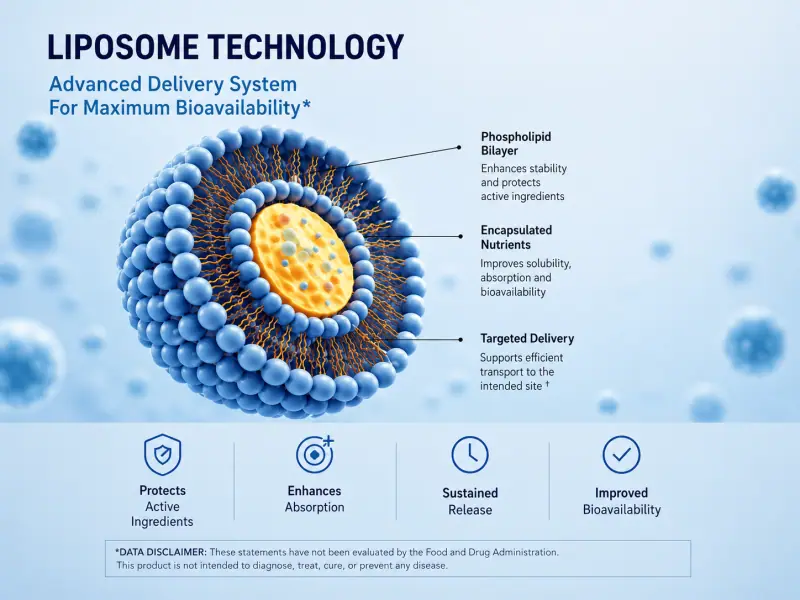
Liposomal glutathione is one of the most searched liposomal supplement ingredients in the United States, and it shows up in capsules, liquids, sachets, and beauty-from-within products. This guide explains what liposomal glutathione is, summarises what a frequently cited human study actually measured, and lists the technical points a brand should check before buying it in bulk.
What is glutathione?
Glutathione (GSH) is a small molecule, a tripeptide made from three amino acids: glutamic acid, cysteine, and glycine. The body produces it in cells, where it is the most abundant non-protein thiol and acts as an important antioxidant. Reduced glutathione is the form usually sold as an ingredient, often labelled L-glutathione reduced.
As a raw material, glutathione has a few known challenges. It has a noticeable sulfur taste and odour, and in solution it can oxidise to glutathione disulfide (GSSG). Researchers have also pointed out that glutathione is subject to breakdown in the acidic environment of the stomach, which is one reason liposomal delivery is studied.
What is liposomal glutathione?
Liposomal glutathione is glutathione encapsulated in liposomes, tiny vesicles whose wall is a phospholipid bilayer. Because glutathione is water-soluble, it sits mainly in the watery core of the vesicle. The phospholipid shell separates it from stomach acid, oxygen, and other ingredients, and it helps mask the sulfur note. For the basics of the carrier, see what is liposomal.
Sheerdds supplies liposomal glutathione powder with a standard glutathione content of 50%, and 70%+ on request. The product page lists a white to off-white appearance, pH 8.5–9.5, a 24-month shelf life, and heavy metal and microbiology limits.
What does the research show?
The study most often cited for oral liposomal glutathione is a pilot clinical study by Sinha and colleagues at Penn State College of Medicine, published in 2018 and available on PubMed Central. Twelve healthy adults took liposomal glutathione at 500 mg or 1,000 mg per day for one month.
The authors reported that glutathione levels in blood rose within one to two weeks, with maximum increases of about 40% in whole blood, and they also reported changes in markers of oxidative stress and immune function. They describe the findings as preliminary: the study was small, had no placebo group, and was funded by a supplement company that supplied the product.
For brands, the honest reading is that liposomal glutathione has promising early human data, not definitive proof. Keep finished-product claims modest and within the structure/function language your market allows, and do not present results from one formula as results for every liposomal glutathione.
Dosage forms for a liposomal glutathione supplement
- Capsules: the powder can be filled into hard capsules; check fill weight against the assay to reach the target milligrams per capsule.
- Sachets and solid drinks: the powder disperses in water to re-form a liposome suspension; flavouring helps cover the residual sulfur note.
- Tablets: possible with careful excipient choice and moderate compression force to protect the vesicles.
- Combination formulas: glutathione is often paired with liposomal vitamin C, NAD+, or CoQ10 in antioxidant and beauty-from-within products.
Liposomal glutathione powder vs liquid
Many retail liposomal glutathione products are liquids. Liquids are convenient for consumers but need careful control of oxidation, microbial growth, and vesicle stability, which affects packaging and shelf life. A dry powder removes most of the water, so it ships at room temperature and fits standard capsule and sachet lines. Our FAQ explains the general advantages of powder liposomes.
Checklist for choosing a glutathione supplement manufacturer
- Glutathione assay and method (HPLC is common), and whether the figure refers to reduced glutathione.
- Particle size, encapsulation efficiency, and how they change during stability testing.
- Phospholipid source and allergen declaration.
- Heavy metals, microbiology, and the limits used (for example USP or EP references).
- Shelf life, storage conditions, and packaging for export.
- Documents: COA, specification sheet, stability data, and quality-system certificates for registration.
- Commercial terms: MOQ, lead time, and whether samples come from a production lot.
According to our product page, the typical lead time for bulk orders of liposomal glutathione is 7–15 business days after order confirmation and payment, depending on quantity and customization.
Quality risks specific to glutathione
Glutathione quality problems usually show up in three places. The first is oxidation: reduced glutathione can convert to glutathione disulfide during processing and storage, so ask whether the assay separates the two forms and how the ratio changes over the shelf life. The second is odour and colour drift, which can signal degradation or interaction with other ingredients in a blend. The third is moisture, because damp powder cakes, flows poorly on capsule machines, and degrades faster.
A practical way to manage these risks is to agree on a specification before the first order, receive a pre-shipment sample from the production lot, and run your own incoming tests on assay, moisture, and microbiology. Keep retained samples from each lot so that any later complaint can be traced.
Labeling and claims for liposomal glutathione products
Glutathione is often marketed with strong antioxidant, detox, or skin-brightening language. Regulators in many markets restrict how these benefits can be described, and some claims are treated as drug claims. Work with a regulatory adviser in each destination market, keep claims at the level of normal structure and function, and include the required disclaimers. Your supplier should provide documents that support ingredient identity and quality, but the finished-product claims remain the brand's responsibility.
Market demand for liposomal glutathione
US search data shows how large consumer interest has become: "liposomal glutathione" alone is searched around 40,500 times a month, with thousands of additional searches for related phrases such as "liposomal glutathione supplement" and "liposomal glutathione benefits". For a brand, this means strong demand but also strong competition from established names, so differentiation through concentration, format, combination formulas, and transparent quality documents matters.
Frequently asked questions about liposomal glutathione
Q1: What is liposomal glutathione in simple terms?
It is glutathione, a tripeptide antioxidant, packed inside phospholipid vesicles called liposomes. The liposome protects the glutathione and is studied as a way to improve oral delivery.
Q2: Does liposomal glutathione work?
A small 2018 pilot study in healthy adults reported higher blood glutathione after one to two weeks of oral liposomal glutathione. The authors called the results preliminary and called for larger placebo-controlled trials.
Q3: What concentration of liposomal glutathione do you supply?
Our standard grade contains 50% glutathione, and 70%+ high-concentration grades can be made on request. Packaging specifications are customizable.
Q4: How should liposomal glutathione powder be stored?
Store sealed in a cool, dry place away from light. The stated shelf life of our powder is 24 months under the recommended conditions.
Q5: Can you make private label liposomal glutathione products?
Yes. We supply bulk powder and support OEM, ODM, and private label projects, including custom concentration and blends with other liposomal ingredients. Request a quote.
Get liposomal glutathione samples and specs
Send us your target concentration, quantity, dosage form, and destination market. We will reply with the COA, specification sheet, and lead time for the matching lot. Request liposomal glutathione pricing.
These statements have not been evaluated by the Food and Drug Administration. Products made with these ingredients are not intended to diagnose, treat, cure, or prevent any disease.