
Published · By Sheerdds
If you have seen "liposomal" printed on a vitamin C pouch, a glutathione capsule, or an NAD+ powder, you have probably wondered what the word really means and whether it changes anything about the product. This guide answers the question "what is liposomal?" in plain language, then looks at it from the side of a brand owner, formulator, or distributor who has to buy the ingredient in bulk.
Sheerdds manufactures powdered liposomal ingredients and sustained-release pellets in Xi'an, China, for supplement, food, and cosmetics brands. Everything below describes the general technology; the specification of any particular lot is set by its certificate of analysis (COA).
What does liposomal mean?
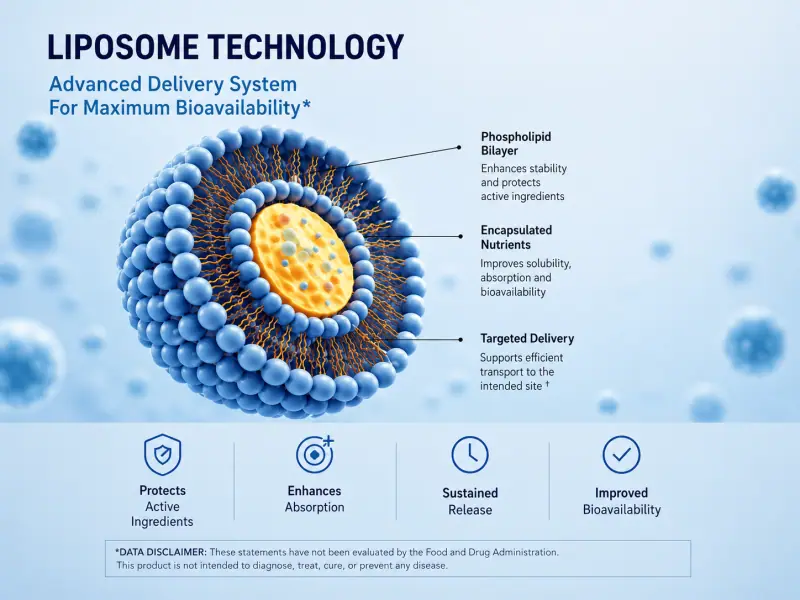
"Liposomal" describes something that is carried in, or made with, liposomes. The word "liposome" comes from two Greek roots: lipo, meaning fat, and soma, meaning body. A liposome is therefore a tiny "fat body": a hollow sphere whose wall is built from fat-like molecules called phospholipids.
When a label says liposomal vitamin C or liposomal glutathione, it means the active ingredient has been encapsulated inside or within the wall of these vesicles instead of being supplied as a free powder or crystal. The active ingredient itself is the same molecule; what changes is the delivery format around it.
Liposomes were first described by the British researcher Alec Bangham in the 1960s, and they have since become a standard research tool and delivery format in pharmaceuticals, cosmetics, and nutrition.
How a liposome is built
Phospholipids have a water-loving head and two water-avoiding tails. In water they line up tail to tail and form a double layer, the lipid bilayer, which closes on itself into a sphere. This is the same basic arrangement found in the membranes of living cells, which is why liposomes are often described as cell-membrane-like carriers.
That structure gives a liposome two places to hold an ingredient:
- The watery core inside the sphere can hold water-soluble ingredients such as vitamin C or glutathione.
- The fatty bilayer wall can hold fat-soluble ingredients such as vitamin D3, vitamin E, CoQ10, or curcumin.
Most food-grade liposomes are made from phosphatidylcholine-rich lecithin, typically from sunflower or soy. Some formulas add cholesterol or other lipids to adjust how rigid the membrane is. Particle size is usually measured in nanometres, and our liposomal vitamin C powder page lists an average particle size of 100–150 nm measured by dynamic light scattering.
What is liposomal encapsulation used for?
Liposomal encapsulation is a formulation tool. Brands and formulators choose it for practical reasons that are easy to explain to buyers:
- Protection: the bilayer separates a sensitive ingredient from oxygen, moisture, and other ingredients in the formula.
- Taste and odour masking: encapsulation can reduce the sour, bitter, metallic, or sulfur notes of ingredients such as vitamin C, iron, or glutathione.
- Combining water- and fat-soluble actives in one carrier for multi-ingredient formulas.
- Absorption: liposomes are widely studied as a way to improve the oral bioavailability of some nutrients. The size of any effect depends on the ingredient, the dose, and the study, so buyers should look at the evidence for each specific ingredient.
We explain the absorption argument in more detail on our why liposomal page and in our comparison of liposomal vs regular vitamin C.
Liquid vs powder liposomal supplements
Most consumer liposomal supplements started as liquids or gels in pouches and bottles. Liquids are simple to make at small scale, but they bring storage challenges: phospholipids can oxidise, vesicles can fuse, and the encapsulated ingredient can leak out over time, so many liquids need careful packaging and cool storage.
Powdered liposomes are produced by drying a liposome dispersion, for example by spray drying, into a free-flowing powder that re-forms a liposome suspension when mixed with water. For B2B buyers, the powder format matters because it can be filled into capsules, pressed into tablets, packed into sachets, or blended into solid drinks, and shipped at room temperature. Our FAQ covers powder liposome storage and dosage forms in more detail.
Common liposomal ingredients
Almost any nutrient can be put into a liposome, but a handful dominate the market because they are popular, sensitive, or hard to take in large amounts:
- Vitamins: liposomal vitamin C, vitamin D3, vitamin E, B12, folic acid, and K2 + D3
- Nutraceuticals: liposomal glutathione, NAD+, CoQ10, curcumin, and berberine
- Minerals: liposomal iron, magnesium, and calcium
You can browse every line in our liposome series or the full product catalog.
How to evaluate a liposomal ingredient supplier
Because "liposomal" is a description of a process, two powders with the same name can be very different. When you compare liposomal supplement manufacturers, ask for numbers rather than adjectives:
- Assay: how much of the active ingredient is in each gram of powder, and by which method it is tested.
- Particle size and distribution, plus the test method (dynamic light scattering is common).
- Encapsulation efficiency, meaning the share of the active ingredient that is actually inside the liposomes.
- Phospholipid source, allergen status (for example soy or sunflower), and any carriers or flow agents.
- Heavy metals, microbiology, peroxide value, and stability data that support the stated shelf life.
- Documents for your market: COA, specification sheet, and the quality-system certificates you need for registration.
Sheerdds supplies these documents with samples, and our certificates page shows the quality-system scans we can share. For private label and OEM projects we can also adjust concentration and blend several liposomal ingredients into one powder.
Liposomal vs other delivery technologies
Liposomes are one of several tools formulators use to change how an ingredient behaves. Microencapsulation and coated pellets wrap an ingredient in a polymer or fat shell to control where and when it is released; our sustained-release pellets work this way. Emulsions and micelles disperse fat-soluble ingredients in water. A liposome is different because its wall is a phospholipid bilayer that can hold water-soluble and fat-soluble ingredients at the same time. The right choice depends on the ingredient, the dose, and the finished format.
Frequently asked questions about liposomal ingredients
Q1: What is liposomal in simple terms?
Liposomal means the ingredient is packed inside tiny spheres made of phospholipids, the same type of fat that forms cell membranes. The ingredient is unchanged; the liposome is the carrier around it.
Q2: Is liposomal the same as liposome?
Liposome is the noun for the vesicle itself. Liposomal is the adjective used for a product or ingredient that is carried in liposomes, such as liposomal vitamin C.
Q3: Are liposomal supplements better than regular supplements?
It depends on the ingredient and the goal. Encapsulation can help with stability, taste, and tolerance, and it is studied for absorption, but the evidence differs from one nutrient to another. Ask your supplier for the data behind each claim.
Q4: Can liposomal powder be used in capsules and tablets?
Yes. Powdered liposomes can be filled into hard capsules, compressed into tablets, packed into sachets, or blended into solid drinks. Heat and shear should be controlled during processing to protect the vesicles.
Q5: Do you offer private label liposomal ingredients?
Yes. Sheerdds supplies bulk liposomal powders and supports OEM, ODM, and private label projects, including custom concentration, blends, and packaging. Request a quote with the ingredient, quantity, and destination market.
Source liposomal ingredients from Sheerdds
If you are planning a liposomal product line, send us the ingredient, target concentration, quantity, and destination market. Our sales team will reply with the COA, assay, pack size, and lead time for the matching lot. Request a quote or sample.
These statements have not been evaluated by the Food and Drug Administration. Products made with these ingredients are not intended to diagnose, treat, cure, or prevent any disease.