
Published · By Sheerdds
NAD+ has moved from research labs into mainstream supplement shelves, and liposomal NAD+ is one of the formats brands ask us about most often. Search data shows strong US interest in terms such as "liposomal NAD+" and "liposomal NAD+ supplement". This guide explains what the ingredient is, how liposomal NAD+ compares with precursor ingredients, and what to check when you source it.
What is NAD+?
NAD+ stands for nicotinamide adenine dinucleotide. It is a coenzyme found in every living cell, where it shuttles electrons in the redox reactions that turn food into usable energy. It is also used by several families of enzymes involved in normal cellular processes. The body makes NAD+ from dietary forms of vitamin B3 and related compounds.
Because NAD+ is central to energy metabolism, it has become a popular ingredient for healthy-ageing and energy positioning. Brands should keep in mind that NAD+ is a larger and more fragile molecule than many vitamins, which creates formulation challenges.
NAD+ vs NMN vs NR
Supplements in this category usually contain either NAD+ itself or a precursor that the body converts into NAD+:
- NAD+ (nicotinamide adenine dinucleotide): the coenzyme itself, supplied as a powder; it is sensitive to moisture, heat, and pH.
- NMN (nicotinamide mononucleotide): a direct precursor, one step away from NAD+ in the salvage pathway.
- NR (nicotinamide riboside): another vitamin B3 form that the body converts to NMN and then NAD+.
- Niacin and nicotinamide: classic forms of vitamin B3 that also feed NAD+ synthesis.
Each option has its own regulatory status, which varies by market and changes over time. Check the current position for your destination country before you finalise a formula.
Why liposomal NAD+?
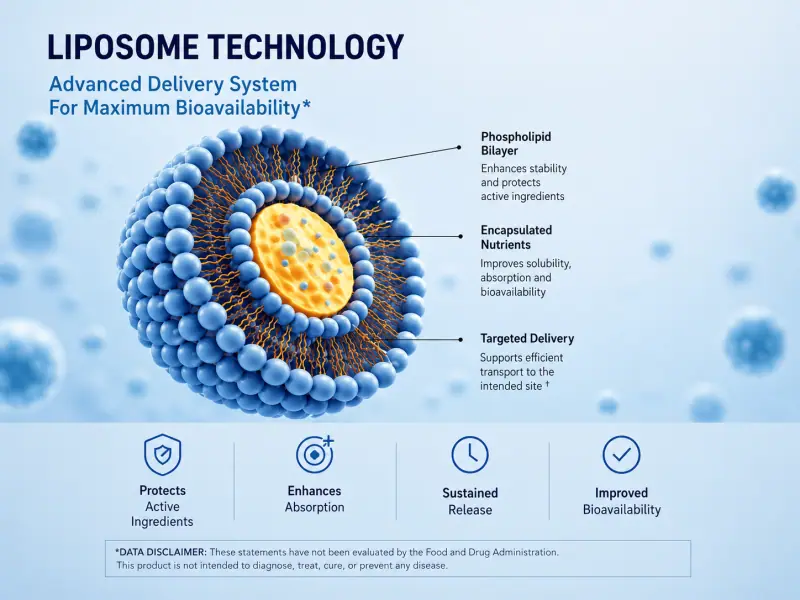
Liposomal encapsulation places NAD+ inside phospholipid vesicles. For a brand, the practical reasons are protection of a sensitive molecule during storage and digestion, a format that blends well with other liposomal actives, and a delivery story that is easy to communicate. If you want a primer on the carrier itself, read what is liposomal.
Human research on liposomal NAD+ specifically is still limited, so absorption or efficacy claims for finished products should be made carefully and backed by data on the actual formula. Positioning around the ingredient, its quality, and its format is usually safer than strong outcome claims.
Liposomal NAD+ also suits brands that already sell other liposomal products, because the same story, the same powder handling, and often the same production line can be reused across the range. That makes it easier to extend an existing liposomal vitamin or glutathione line with an NAD+ product.
Key specifications for liposomal NAD+ powder
Our liposomal NAD+ powder is offered at two standard concentrations, and the product page lists the following:
- 50% NAD+: standard grade, a cost-effective choice for capsules and blends.
- 70% NAD+: high-concentration grade for premium lines that need more NAD+ per serving.
- Appearance: white to off-white powder; other concentrations available on request.
- Registration support: COA, specification sheet, stability data, and nutritional panel.
- Heavy metals described as compliant with USP/EP standards.
When you compare suppliers, confirm how the NAD+ content is tested, what the remaining percentage of the powder consists of, and how particle size and assay hold up in stability testing.
Formulation tips
- Calculate fill weight from the actual assay: a 500 mg capsule of 50% powder contains about 250 mg NAD+.
- Protect from moisture during blending and filling, and use packaging with good moisture barrier properties.
- Avoid high heat; add the powder late in processes that involve heating.
- Consider combinations with liposomal glutathione, CoQ10, or B vitamins such as liposomal vitamin B12 for energy and healthy-ageing formulas.
Wholesale, OEM, and private label options
Sheerdds supplies liposomal NAD+ as a bulk ingredient and supports OEM and ODM projects. According to the product page, our services include custom packaging and labeling, concentration adjustments, blending with other liposomal ingredients, and documentation support for product registration. MOQ depends on the project; we accept small trial orders as well as large bulk shipments.
For a smooth quote, send the target concentration, quantity per order, dosage form, and destination market. You can also browse our liposomal nutraceuticals line for related ingredients.
Quality questions to ask about NAD+ raw material
NAD+ is produced by fermentation or enzymatic processes, and the quality of the starting material affects the quality of the liposomal powder. Ask your supplier how the NAD+ content is measured (HPLC is common), whether related substances such as nicotinamide are reported, and what the acceptance limits are. Ask for moisture data, because NAD+ powders pick up water and degrade faster when damp.
For the liposome itself, request the particle size, encapsulation efficiency, phospholipid source, and allergen status. Finally, ask for stability data at the storage conditions you will actually use, so that the shelf life on your label is supported by data rather than assumptions.
Positioning and label claims
NAD+ products are often marketed with energy and healthy-ageing language. In the United States, dietary supplement claims must stay at the level of normal structure and function and carry the standard FDA disclaimer. Other markets have their own ingredient approvals and claim rules. Build the label with a regulatory adviser for each market, and use the documents from your ingredient supplier to support identity, purity, and quality.
Market demand and product ideas
US search data shows steady consumer interest: "liposomal NAD+" is searched around 5,400 times a month and "liposomal NAD+ supplement" around 2,400 times, with additional volume for "liposomal NAD". Popular product formats include capsules, powder sachets mixed into water or coffee, and combination formulas that add glutathione, CoQ10, resveratrol, or B vitamins. Powdered liposomal NAD+ is a good base for all of these because it can be filled, blended, or packed on standard equipment.
If you are building a range, consider launching a single-ingredient NAD+ capsule first and then extending into combinations once you have consumer feedback and stability data for the base product.
Frequently asked questions about liposomal NAD+
Q1: What is a liposomal NAD+ supplement?
It is a supplement that contains NAD+ encapsulated in phospholipid vesicles called liposomes, supplied as capsules, powders, or liquids. The liposome is a carrier that protects the NAD+ molecule.
Q2: Is liposomal NAD+ the same as NMN?
No. NMN is a precursor the body converts into NAD+, while liposomal NAD+ contains the NAD+ molecule itself inside a liposome. They are different ingredients with different specifications and regulatory status.
Q3: Should I choose 50% or 70% liposomal NAD+?
Choose 50% for cost-effective products and blends, and 70% when you need more NAD+ per capsule or serving. Base the decision on your target dose, capsule size, and price point.
Q4: How is liposomal NAD+ powder stored and shipped?
The powder form needs no refrigeration according to our product page. Keep it sealed, cool, and dry, and protect it from moisture after opening.
Q5: Do you sell liposomal NAD+ wholesale?
Yes. We supply bulk liposomal NAD+ powder for brands, contract manufacturers, and distributors, with OEM and private label support. Request a quote.
Request liposomal NAD+ samples and pricing
Tell us your concentration, quantity, and market. Our sales team will send the COA, specification sheet, pack size, and lead time for the matching lot. Get a liposomal NAD+ quote.
These statements have not been evaluated by the Food and Drug Administration. Products made with these ingredients are not intended to diagnose, treat, cure, or prevent any disease.